Σχολές της Γαλλικής Σχολής Canyoning στην Κρήτη - EFC stages in Crete 2015
(Original in Greek — see ελληνική έκδοση)
Quick notes and references
(Original in Greek — see ελληνική έκδοση)
(Original in Greek — see ελληνική έκδοση)
(Original in Greek — see ελληνική έκδοση)
(Original in Greek — see ελληνική έκδοση)
(Original in Greek — see ελληνική έκδοση)
(Original in Greek — see ελληνική έκδοση)
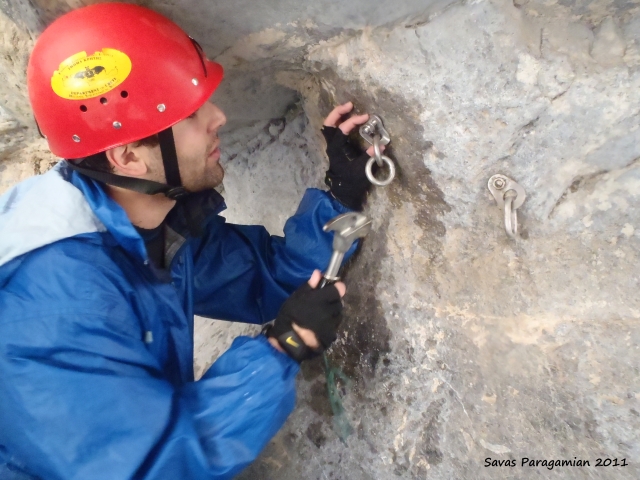
On 4 August, together with Manolis Spinthakis, we visited Kalami II (also known as Panagia) canyon for some anchor improvements. Specifically, 8 bolts and plates were installed to create bypass options and automatic horizontal traverses, donated by the HSS Crete Section.
Kalami II is a small canyon with few and short but consecutive descents. It is narrow, 3–7m wide throughout, with several meanders. The absence of pools means it can be descended year-round with or without water. Entrance at 270m altitude, exit at 140m (difference 130m). 11 technical rappels, longest 16m.
16 August 2010 — Savas Paragkamian, Manos Petrakis and Thanos Kardasis repaired the anchors on the Kourtaliotis waterfall (15m, with a mid-ledge), south Rethymno. The waterfall appears beside the church of Agios Nikolaos in the gorge bed.
This is the only permanently flowing waterfall in Crete — dangerous to descend in winter and spring. Anchors had been destroyed by water flow and rockfall. Three bolts, one chain and three plates installed.
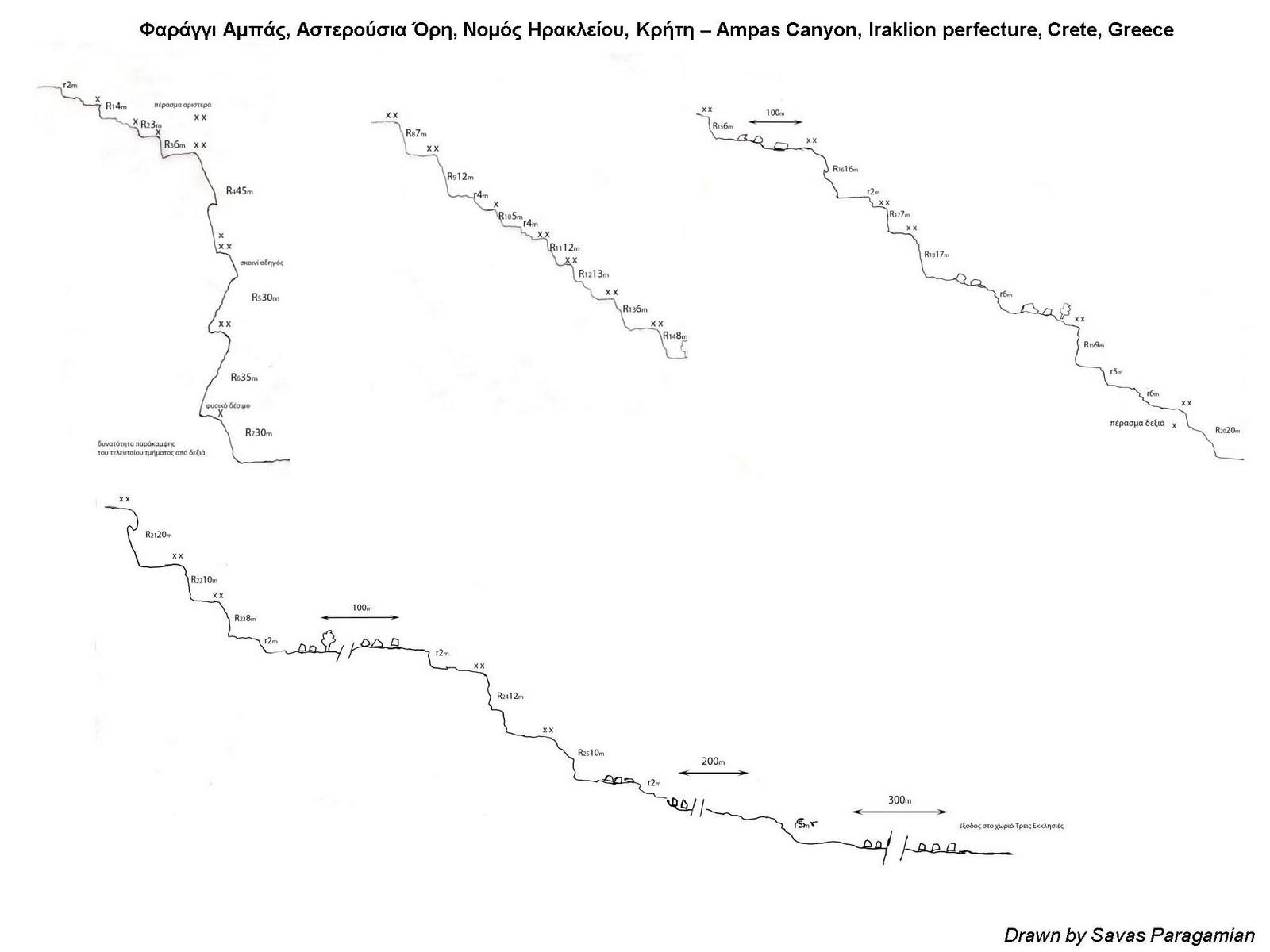
18 July 2010 — Savas Paragkamian, Yiannis Vargiyakakis and Manos Petrakis installed 17 bolts and plates in Ampas canyon as part of the HSS Crete Section bolting project.
Ampas: south Heraklion, Asterousia range. Entrance at Paranymfoi village (480m), exit at Tris Ekklisies (sea level). 25 rappels, longest 45m. Known for a 140m waterfall immediately after the third descent, split into four sections. Large waterfalls are a feature of Asterousia canyons (Agia Paraskevi, Mesosfinι, Ethiano, etc.). Dry outside winter and early spring.
The HSS Crete Section has included the re-rigging of ten well-known Cretan canyons in its action plan. Goal: install additional plates so every waterfall meets the two-point anchor rule, and build horizontal traverses on exposed rappels. On completion the canyons will be suitable for both guided descents and training.
(Original in Greek — see ελληνική έκδοση)
After finishing secondary school exams I needed a change of scene. The EFC (École Française de Descente de Canyon) was running an Initiateur (assistant instructor) course in the Pyrenees in late June — too good to miss. Departed 18 June, five days after exams ended, via Barcelona.
Barcelona (18–20 and 28–30 June): impressive urban grid, wide boulevards, cycle lanes, parks.
EFC Initiateur course, Pyrenees: technical canyoning instruction and beginner teaching methodology, practised in southeast French canyons.
(Original in Greek — see ελληνική έκδοση)
Vasilis Vagias published his first canyoning video — footage from Portela, Ha and Arvi canyons during winter 2009–2010, a season with unusually high water flow. Shot with Yiannis Skontinakis.
(Original in Greek — see ελληνική έκδοση)
A record of outings with my mentor Yiannis Bromirakis during 2007–2008: Psistrakis pit (May 2007), Tsakalos pit (July 2007), Kamares canyon (July 2007), the POEF canyoning school, and securing the Mastoras waterfall on Ha canyon (February 2008).
Yiannis is the person who shaped how I move in the mountains. He taught me rope work when I was in my first year of secondary school. Our friendship ended unexpectedly in late 2008 — I still don’t understand why these ruptures happen so often in mountain communities.
13 September 2009 with Yiannis Vargiyakakis, Afroditi Kardamaki, Manos Petrakis and Stelios Lamprinos. Ethiano canyon lies in the Asterousia range: entrance at Ethia village (670m), exit at Rotasi (282m). Carved through the Ethia series platy limestone — the spectacular fold structures in the walls are the canyon’s defining feature.
First descended by Yiannis Bromirakis and Yiannis Skontinakis in 2005. Twelve technical descents, longest 37m (the middle section of a broken 65m waterfall). We used a tyrolean traverse to avoid a 1.4m-deep brown pool — which deepens when you’re carrying a pack.
The “Psari 2009” expedition of the Hellenic Speleological Society surveyed 101 pits. Among them: Akolie Psaris (code Ψ207), reaching −442m — the 13th deepest cave in Greece. Located on the Psari summit of the White Mountains (Chania) at 1560m elevation.
Four consecutive vertical shafts:
At the final floor, a northern passage ends at a squeeze (blasting failed to open it); the southern passage — with water flow and strong air currents — leads through tight meanders to a squeeze at −442m that clearly continues.
14 April 2009 visit with Afroditi Kardamaki, Manos Petrakis and Niovi Stasinou. Psistrakis is a place that gives far more than we can return — the least we can do is respect it.
We found discarded carbide residue and rubbish scattered through the cave. People who treat a cave this way should not call themselves cavers.
Chitres (cave pots): on the floor of the final 80m shaft, erosion pots formed by dripping water from high ceilings — the falling drops set pebbles spinning, drilling circular holes in the rock. The sound of the spinning pebbles gave the formation its Greek name. When the enclosed pebbles become coated white by salt deposits, they are called “cave pearls.”
(Original in Greek — see ελληνική έκδοση)
(Original in Greek — see ελληνική έκδοση)
1 March outing with Yiannis Skontinakis and Vasilis Vagias to Lapathos canyon (also called Agioi Apostoloi). The highlight: water appeared suddenly in the 80m final waterfall — completely unexpected, and a reminder of how unpredictable mountain conditions can be. Snow was present above 800m that day; the melt likely drove the water.
Probably the second largest technical canyon in Crete after Kamaraiko: 4km long, 900m altitude drop, 28 rappels (longest 80m), entrance at 1250m.
(Original in Greek — see ελληνική έκδοση)
1 February visit with Vasilis Vagias and Yiannis Skontinakis to Portela canyon. Entrance at Hondros village, exit at Keratokambos, south Heraklion.
Portela carries the highest water volume of any canyon in its region (Kavousi, Tsoutsouros, Arvi). 25 technical descents, longest 30m, altitude drop 340m. Legendary locally and one of the best-known technical canyons in Crete alongside Ha and Arvi.
Geology: thin-bedded Pindos limestone, intersected by five faults dividing it into three distinct sections with varied vegetation. Unusual large mud deposits from the “Viannos” formation upstream. The final rappel is on rotten rock that prevents continuation beyond it.
(Original in Greek — see ελληνική έκδοση)
Kavousi canyon is located at Keratokambos (Ano Viannos, south Heraklion) in the Dikti range. Carved through thin-bedded Pindos limestone by three faults — one at the entrance, one at the exit (both perpendicular to the gorge), and one along its eastern side. The entrance fault intersects Portela canyon to the west.
Ten rappels, longest 20m; total length 1km, altitude drop 170m. Water only in spring and after heavy rainfall. The high-water marks on the walls suggest that when the gorge floods, almost the entire walkable section is submerged.
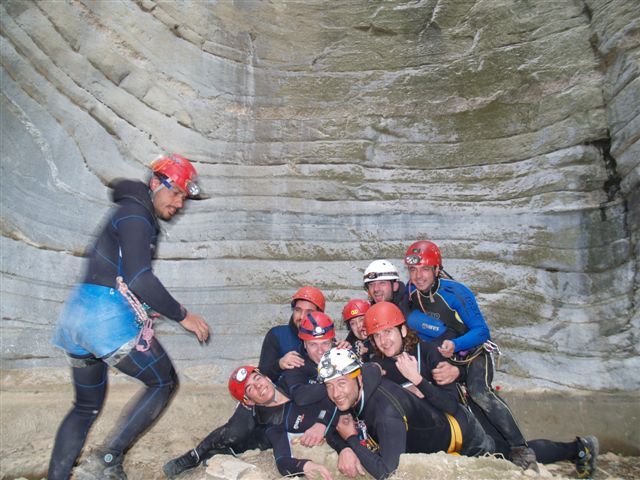
Ha canyon lies near Ierapetra in the Thrypti range, Lasithi. One of the three most famous technical canyons in Crete alongside Arvi and Portela, and considered among the ten most beautiful in Europe, attracting ~300 visitors a year.
Created by an active fault that raised the mountain ~300m in platy crystalline limestone — a textbook example of canyon formation. The V-shaped profile with walls up to 300m is visible from as far away as Agios Nikolaos. Length 1.5km, altitude drop 230m (entrance at 370m, exit at 140m), ~30 rappels, longest 35m.
(Original in Greek — see ελληνική έκδοση)
A Boxing Day trip with Yiannis Skontinakis and Yiannis Vargiyakakis to Arvi canyon — a festive, relaxed outing.
Arvi canyon lies north of the village of Arvi (south Heraklion, near Keratokambos), carved through massive limestone of the Dikti range. It drains toward the Libyan Sea but the water is diverted for irrigation before reaching it. Internationally known, with nearly 2km length and 250m altitude drop, 13 descents (largest 80m), and a distinctive 150m dark narrows — rare in gorge canyoning.
Fantaxospiliara is a fossil cave system in Rethymno — once an active underground river, now inactive after significant tectonic shifts. Fossils are visible at the entrance. Its bat colonies have declined sharply in recent years.
Visited on 30.11.2008 as part of an HSS Crete Section field seminar, where trainees practised cave surveying and photography.
In August 2008 I volunteered with WWF Greece on an inventory survey of 12 wetlands in southern Euboea. Two of them — at Myti and Merouti, just 500m apart at the island’s southeastern tip — stood out for their untouched beauty. Finding landscapes that genuinely undisturbed is rare.
The survey was part of WWF’s programme for the protection of Aegean island wetlands.
I chose unonoctium as a pseudonym because I was struck by the fact that it is the last element in the periodic table — an element whose existence was predicted long before it was synthesised, finally created artificially in 2006. The correct name is ununoctium, but that was taken on YouTube.
03.02.2008 — the Mastoras waterfall was rigged for descent. This lateral gorge pours vertically into Ha canyon at 215 metres — the tallest waterfall in Crete.
Team: Yiannis Bromirakis, Katerina Hatzidimitriou, Maya Hristodoulaki, Savas Paragkamian.
Effect on Ha canyon: the final third of Ha is typically dry before this point; after the Mastoras inflow it runs with heavy water.
Psistrakis is one of the most beautiful pit caves in Crete, and carries a personal history: on 09.01.1990 my father Kaloust Paragamian nearly died of hypothermia after emerging from it. That near-death experience led to a decision that resulted in my birth.
The cave is 120m deep. A narrow entrance (1×1.5m) opens into a 40m shaft, then a 15×6m chamber with gour pools, a 20m gallery, and a spectacular lake (10m long, 1–1.5m deep). Beyond the lake, a tight squeeze leads to the final 80m shaft, heavily decorated with speleothems.
(Original in Greek — see ελληνική έκδοση)
Kamaraiko is the largest technical canyon in Crete: 5km long with 1260m altitude difference between entrance and exit, and one of the most beautiful. Located near the village of Kamares on Mount Psiloritis.
Visited on 01.07.2007 as part of POEF explorations, with Yiannis Bromirakis, Katerina Hatzidimitriou, Stavros Zembilis, Eleni Diarivianaki.
(Original in Greek — see ελληνική έκδοση)
The 4th Pan-Cretan Speleology Symposium took place in Zoniana on 25–26 October 2008, attended by 65 participants from Crete, Athens and Thessaloniki. Twenty-two talks covered new cave discoveries, environmental education, geology, palaeontology, archaeology, biology and cave management.
My first conference presentation: speleological research in Sitanos (Siteia, Lasithi), co-authored with Kostis Foteinakis, Afroditi Kardamaki and Georgia Papadokostaki.
(Original in Greek — see ελληνική έκδοση)
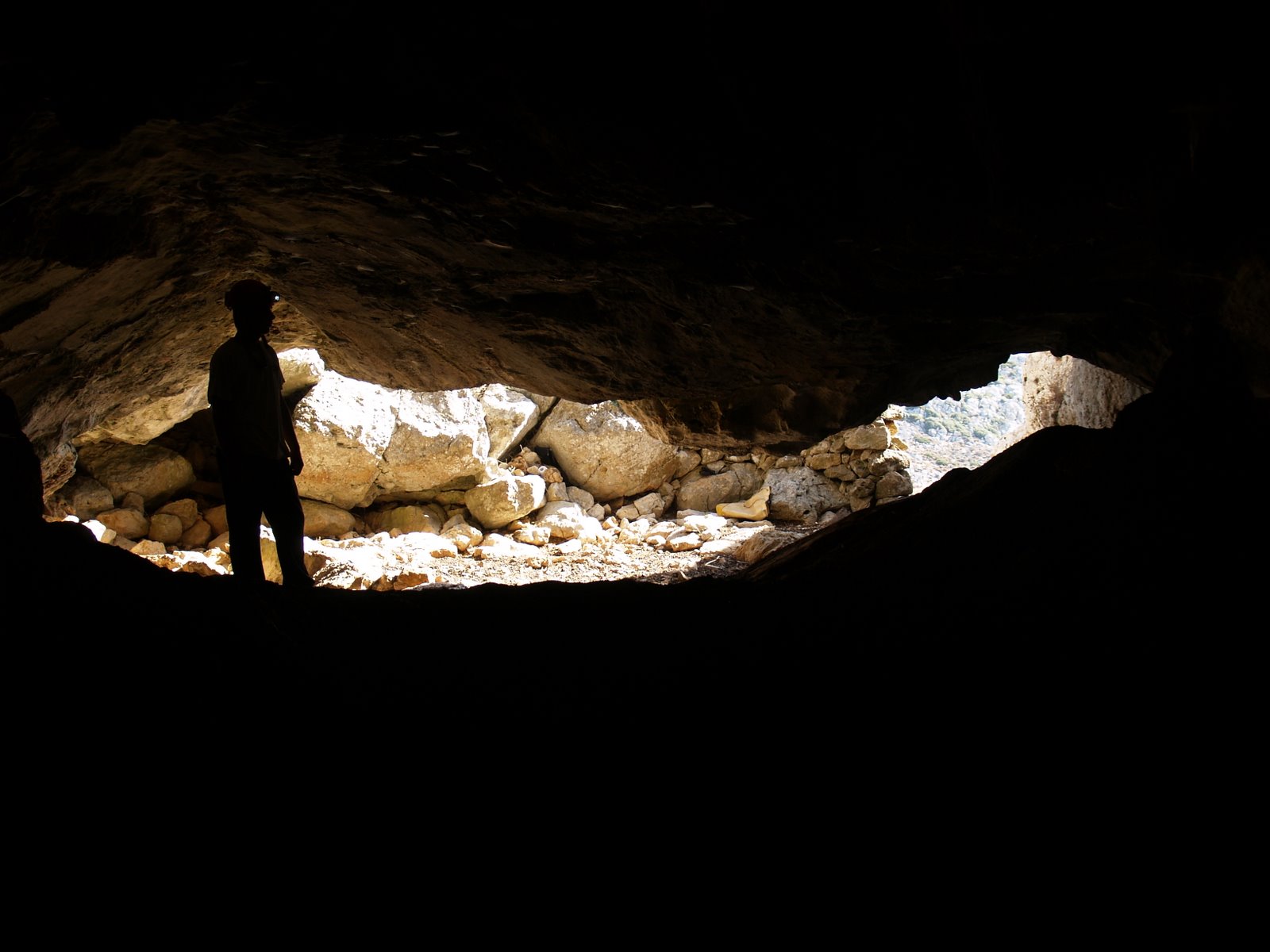
Field survey completed with Kostas Foteinakis in Sitanos (Siteia municipality, Lasithi), mapping Therospilios cave. HSS Crete Section explorations in this area began in 1993; the 2007–2008 campaign added 6 cavities:
The most significant cave in the wider area is Oxo Latisidi. Results presented at the 4th Pan-Cretan Speleology Symposium.
(Original in Greek — see ελληνική έκδοση)
28.09.2008 — trek with Yiannis Skontinakis in the southern White Mountains. Departed from Koustogerako village, reached a point just past Fantasm gorge (~5km). Dense fog (visibility ~10m) made for an atmospheric outing.
Purpose: GPS waypoint logging for a mountaineering group (POA) planning to cross the route at end of October.
(Original in Greek — see ελληνική έκδοση)
Richard Wright died on 15.09.2008 aged 65 from cancer. Founding keyboardist of Pink Floyd (1965), alongside Syd Barrett, Roger Waters and Nick Mason. He left after The Wall due to disagreements with Waters, returning in 1986.
Albums: Dark Side Of The Moon (1973), Wish You Were Here (1975), Animals (1977), The Wall (1979), The Final Cut (1983), The Division Bell (1994).
(Original in Greek — see ελληνική έκδοση)
Six expeditions between March and September 2008 to survey 10 cave cavities in the municipality of Nikiforos Fokas, Heraklion. Work included cartography, photography and biological sampling (invertebrates, owl pellets). Caves explored included Peristere (−25m), Tsitospilio, the Forty Michaelides Hole, and Beleha i Trypa (−28m) near Saitoures.
Results were presented at the 4th Pan-Cretan Speleology Symposium by Manos Petrakis.
07.09.2008 — Yiannis Skontinakis, Savas Paragkamian, Kostas Kartsonos and Haris Stivaktakis visited the village of Tapes in Lasithi to explore the legendary local pothole “Latisida”. Villagers believed it to be over 400m deep.
Actual depth: 20 metres. The floor contained three cylindrical crates (likely ammunition boxes), 2m tall and 40cm in diameter, probably thrown in during the German occupation, along with sheep and goat bones.
(Original in Greek — see ελληνική έκδοση)